Thursday, October 12, 2006

Filtres for dirty buses

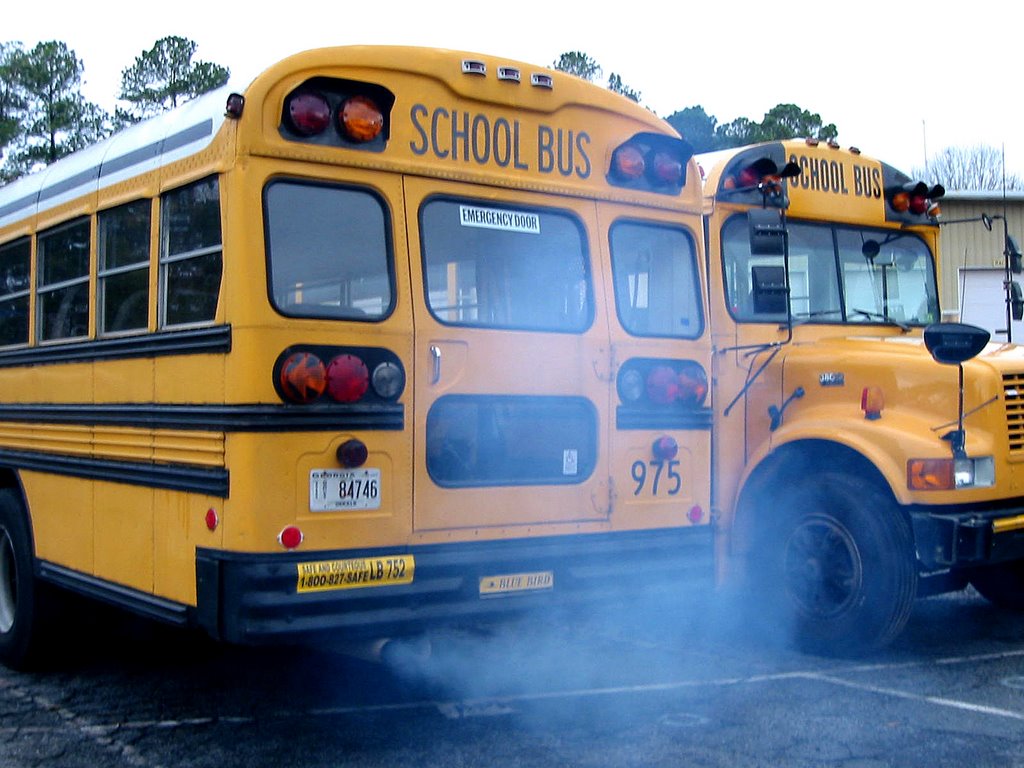
School bus and large diesel vehicle exhaust can be a toxic source of bad air, particularly for young kids. The effect of these emissions on small lungs (never mind adults) can be catastrophic. They’re blamed for a host of children’s illnesses, from asthma to cancer.

The good news is that the school bus fleet operated by Stock Transportation across Halifax Regional Municipality has just been replaced with many newer buses with cleaner exhaust.

The bad news: look at all the older "smoking" diesel trucks and buses still out there. You'll want to avoid following one in traffic, if you can help it. Especially if your child in the back seat is asthmatic.

To look into the future of where Halifax may be headed in eventually addressing this problem, read how one school district in Massachusetts is retrofitting its’ school bus fleet with filters. The impact on kids’ health and the environment is expected to be dramatic. Read the story here.

To read more about the filtering technology available, visit here.


Tuesday, September 26, 2006

The garage test

The STOP YOUR ENGINES campaign for me really started in earnest when I started talking to the kids at the elementary school in our subdivision.


I had done some basic research on idling and had simplified the presentation for the grade fours, fives and sixes. Kids love imagining pictures in their heads, so I used statistics that would easily create images for them.

That’s when the size of the problem really hit home for me. I’ll never forget the statistic from the federal government that states: “the average motorist traveling 20,000 km a year puts out 4 ½ tons carbon dioxide a year…or, about 3 x the weight of your car!”


I created the slide to provide the picture for the kids’ imaginations. I still didn’t really quite believe it myself. Until almost a year later.

I was backing my car into my garage, when I left the engine on for just a few extra seconds. When I got out and around my vehicle, I was overcome by the heaviness and sour taste of the air. The garage door was still open. And I was driving a new, highly efficient subcompact.

I now believe that statistic.

Try it yourself. If you have a garage, check to see what the air’s like in that confined space after only a few seconds. It’s unbelievable. For me, it reinforced the urge to turn my car off every chance I get.

Visit Natural Resources Canada's IDLE-FREE ZONE here.
Visit The David Suzuki Foundation's Drive Smart site here.

Thursday, September 21, 2006

The perfect way to approach people on STOPPING THEIR ENGINES.

There’s a lot of underlying support for the idea of cutting back on idling in Halifax Regional Municipality. HRM has had surveys done in which people said that poor air quality was a key concern and that 80 per cent of people would stop idling if they were reminded.

Many grown ups are uncomfortable approaching other adults to ask them to shut their car off when they’re parked. I know—I started out that way myself. Until the notion of this simple tool came along.

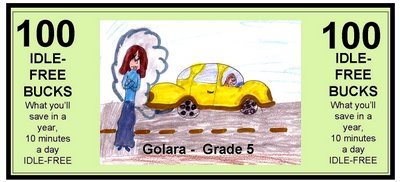
Try printing off your own IDLE FREE hundred dollar bills. Simply walk up to someone idling and ask them: “how would you like some free gas money?” About 98 per cent of the time their eyes light up and they say “sure!” Hand them this hundred dollar bill. Nine times out of ten, a wry smile comes across their face as they turn their car off.


Often times they say, “hey, this is a great idea. Thanks for reminding me. I keep forgetting.” The kids’ artwork on the front reinforces how important an issue poor air quality is for kids.

Click on the hundred dollar bill for your two-sided bills featuring idling myths.


If you want to see the IDLE FREE BUCKS work almost 100 per cent of the time, have your child present the bill to the person idling. You’ll be touched by the response. They’re humbled by the realization that a member of a future generation is asking them to consider their present habits.

*****ONLINE EXTRA Going green or clean isn’t just for “tree-huggers” anymore. It’s mainstream politics and business in the U.S.

Read the BusinessWeek article about how the U.S. Congress is poised to leave Canada in its dust with landmark legislation on global warming: Global Warming Heats Up Capitol Hill

Saturday, September 16, 2006

Why idling??

People often ask me: "why did you pick idling as your issue?" Good question. I can speak from experience, since I used to idle a lot myself.

I started seeing the headlines and cover stories in places like National Geographic (“Global Warning”), Time magazine’s cover (“Be Worried, Be Very Worried”).

It wasn’t so much ME that I was worried about. It was my kids (below). What kind of planet will they get in 10 years? ---what about THEIR kids?


I felt I had to do something. I suspect most Canadians are bewildered right now and many of us are in a state of denial about all the bad news on climate change.

So, just as I needed something to do…mainstream Canadians need something easy to do, to make a difference on climate and the air. The hook is when they start thinking about their kids.

Look into your kids’ eyes and imagine their future if we all do nothing.

Idling is the easiest thing to do to make a big difference when you’re outside your home. It’s the equivalent of turning off a light switch. You turn a key off, whenever you’re parked.

You don't need a government grant, you don't need a refit, you don't need to make an investment.

But the numbers will grab you too: turning off the key for just 10 minutes a day, motorists would easily save the cost of several fill-ups in a year. Collectively, the numbers are staggering: annually Halifax would save 5 million litres of fuel and avoid pumping almost 12,000 tonnes of CO2 into the air.

Do you want cleaner air for your children to breathe in HRM?
Do you want to save money?
Do you actually want to protect your car investment and its engine?
Do you want an easy way to help reduce greenhouse gas?

If we can't turn a key to save gas, protect our kids lungs and their air, what WOULD we be willing to do?

What you can do:
STOP YOUR ENGINE whenever you can.

Here’s something else you can do: “if it’s not a problem, it’s not a problem.” Right now, most people forget about this issue. And if it’s not top-of-mind, it’s not a problem.

You can make it a problem though. You can contact your councilor in HRM by e-mail or phone and say you want HRM to endorse The Children’s Clean Air Network. HRM Councilors.

Our goal is to get the politicians in HRM to see the children as constituents who want cleaner air and a brighter future. We want a long-term public awareness campaign on this issue. Most of it will be paid for by donations. Much of it will be paid for by the savings HRM will realize when we get all their departments to STOP THEIR ENGINES.

Read how the City of Edmonton saved taxpayers $205,000 in the most recent effort in fleet driver training: $205,000 bucks!


What are we waiting for?

******Today's cool site..the U.S. government has a great resource here: you want fuel economy? You GOT fuel economy!
Thursday, September 07, 2006

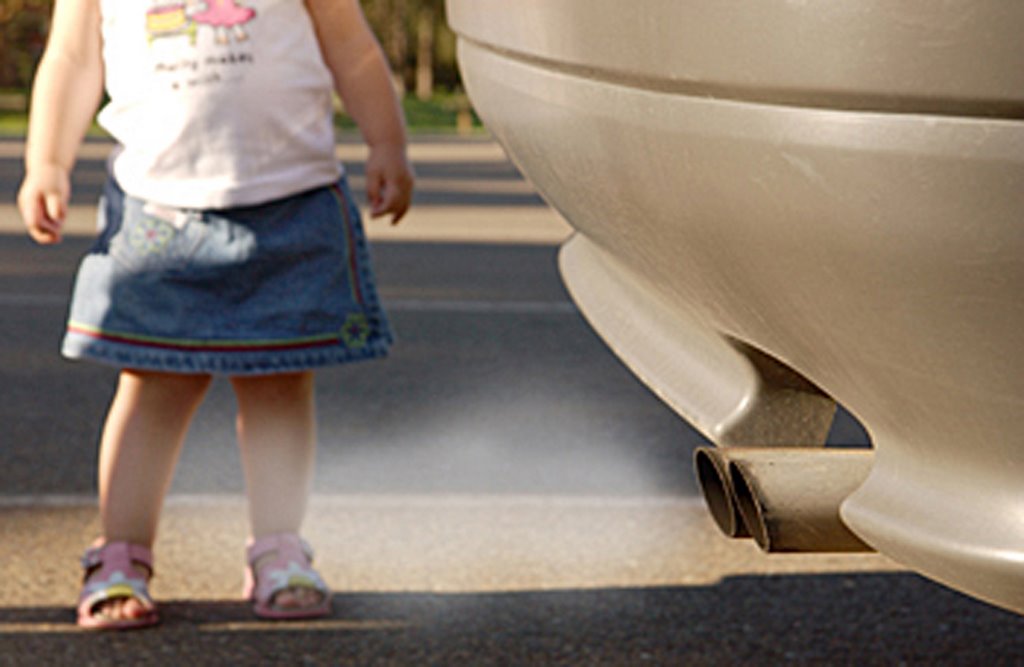
The little girl and the tail pipe: the image that haunts me


This is an image that spurs me on to keep at it. For me, it represents two key points.

  • The lack of awareness on what our habits are doing to kids
  • The exhaust is an attack on her future planet

Maybe if I didn't have two kids (ages 11 and 12), I wouldn't be so consumed by this. But then again, with all the headlines about climate change and the ticking "carbon bomb", you wonder why more people with children aren't.

Tell your friends and neighbours to stop their engines whenever they can. It's so simple to do, and it can lead to an entire shift in thinking to protect our children's future.

Wednesday, September 06, 2006

Wasted fuel, damaged air: the numbers for Halifax

People ask: "how do you come up with those numbers...the amount of gas that's wasted and CO2 pumped into the air,"---by people idling?

Natural Resources Canada does that work for us. Simply visit here: The CO2 Calculator

You'll find an easy to use calculator where you can plug in idling time and cost-per-litre for gas, and voila, you have the damage.

HRM is broken down into several areas whereby you can actually identify the numbers for specific areas like Dartmouth, Lower Sackville, Eastern Passage, Hammonds Plains and so on.

For Lower Sackville, as an example, I used 9 minutes a day of idling at $1.00 a litre for gas. Here's the results:

If every driver of a light-duty vehicle in Lower Sackville avoided idling for 9 minutes a day, they could prevent 7.84 tonne(s) of carbon dioxide from entering the atmosphere each day.

That's 2,859.93 tonne(s) per year!

That's enough CO2 to fill The Sackville High gymnasium 486 times.

Motorists in Lower Sackvile could collectively avoid wasting 3,320.1 litres of fuel worth $3,320.10. On an annual basis, that's savings of 1,211,836.5 litres worth: $1,211,836.48.

Click on IDLE-FREE bucks on the right. Keep one as a reminder in your car; you'll save yourself several fill-ups a year by avoiding idling for just ten minutes a day.

Tuesday, September 05, 2006

Kids plead with grown-ups in video: stop your engines

Kids want adults to stop idling their vehicles whenever possible. Needless idling is affecting their health and the future of their planet. It also costs a lot of money.


The Children’s Clean Air Network (CCAN) is a network of like-minded partners with one goal in mind for Halifax Regional Municipality: reducing vehicle emissions which will improve the quality of our air and reduce the threat from climate change. CCAN was born out of a grassroots reduced-idling campaign in Kingswood subdivision (www.kingswood.ca).

Like-minded partner organizations include: Clean Nova Scotia, The Ecology Action Centre, The Lung Association of Nova Scotia and the Halifax Regional School Board. CCAN also collaborates with local environmental and business organizations, including the Eco-Efficiency Centre.

CCAN seeks to apply its strategies and tactics across HRM to assist the municipality in becoming a Canadian leader in reducing vehicle emissions. Needless vehicle emissions are a serious threat to the health and future of our children and a waste of resources. CCAN seeks to educate the public on the seriousness of this threat and to help children be heard on this issue.